Federal agencies buy modular construction through four procurement paths: GSA Schedule task orders, DLA-TLS sourcing, open-bid solicitations on SAM.gov, and lease agreements against contractor inventory or new builds. The modular construction services federal agencies order span design, manufacturing, site development, installation, and the warranty and service that follow acceptance. This guide covers the vehicles, the vendor record to verify, secure-facility scope, and the lease-versus-purchase decision.
Four ways federal agencies buy modular construction
Every federal modular award moves through one of four procurement paths, and the right one depends on the agency, the scope, and the timeline:
- GSA Schedule. Direct ordering under a Federal Supply Schedule contract. No separate competitive bid is required for in-scope work; the agency issues a task order against the Schedule. MMG holds GSA Schedule GS-07F-0222X under FSS 056, Buildings and Building Materials / Industrial Services and Supplies.
- DLA-TLS. The Defense Logistics Agency’s Tailored Logistics Support program, used for defense and intelligence sourcing. MMG is a DLA-TLS prime; the program is the right path when GSA isn’t the fit, including secure scopes and quick-turn units.
- Open Bid. Competitive solicitations posted to SAM.gov, including set-aside and full-and-open opportunities. MMG’s Certified Small Business status qualifies it for set-aside categories, confirmed by NAICS code per solicitation.
- Lease and Available Inventory. Leasing a permanent or relocatable building from contractor inventory or as a custom delivery, with lease-to-purchase available.
A buyer who knows which path the requirement fits saves weeks before the first vendor conversation. The rest of this guide covers what to verify once the path is picked.
The modular construction services federal agencies can put on contract
Federal modular scope is wider than the building. A complete delivery from a Design-Build General Contractor includes design, manufacturing, site work, installation, and post-acceptance support, and the buyer should confirm the vendor holds all of it rather than brokering pieces out. MMG self-performs or directly manages the full scope:
- In-house design: concept drawings, structure, layout, foundation, finishes, and manufacturing engineered drawings, produced under a registered Architect AIA.
- Factory fabrication in wood, steel, or concrete framing, single-story or multi-story, permanent or relocatable.
- Site development: demolition, excavation, grading, foundation construction, and site utilities.
- Full MEP scope: HVAC, plumbing, fire alarm, and electrical systems.
- Data communications, including SIPRNet provisioning where the contract requires it.
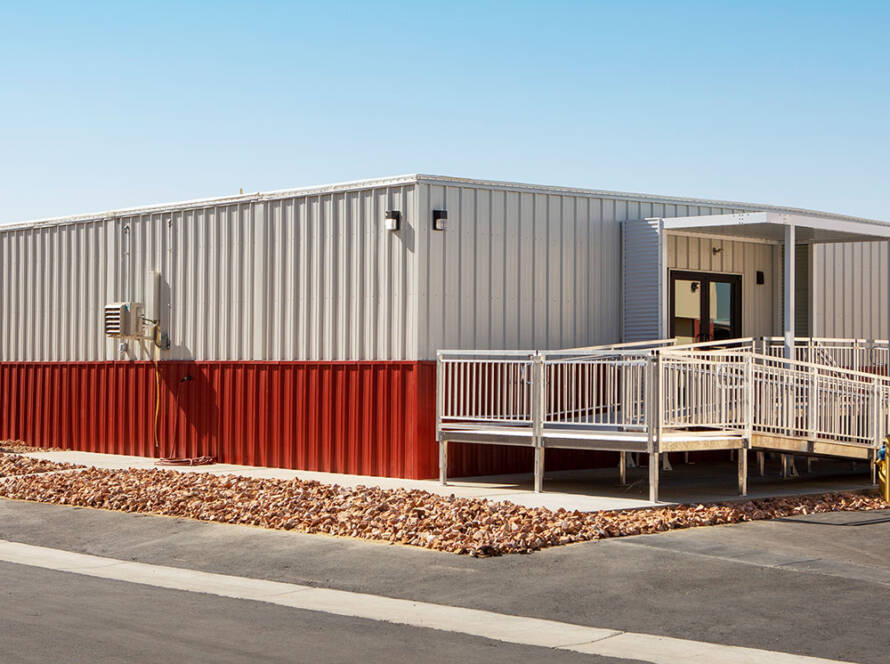
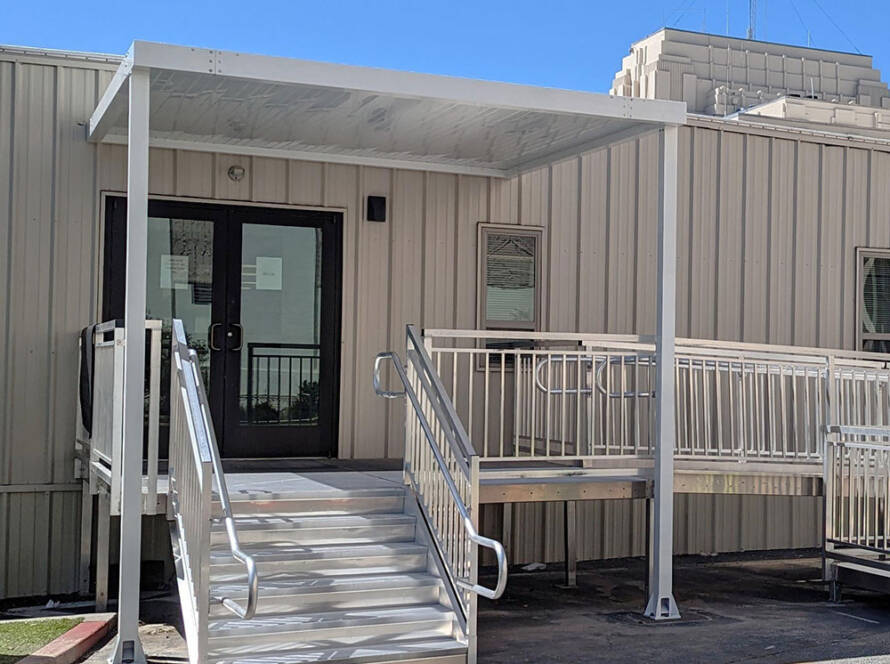
- Building access (ramps, steps, decks, canopies) and FF&E.
The reason scope breadth matters is accountability. When the designer, the factory, the site crew, and the service team sit inside one company, the agency holds one contract and one point of responsibility. When they sit inside four companies, every interface is a seam where schedule and warranty obligations can slip.
The vendor record to verify before shortlisting
A federal modular vendor is a set of checkable records before it is anything else. The fastest evaluation starts with the registry data: an active SAM.gov registration, a UEI and CAGE code that match the proposal, and NAICS coverage that fits the solicitation. MMG’s record reads: UEI CYU2FMJ3JM58, CAGE 46Y71, Certified Small Business, active in SAM.gov, with eleven NAICS codes led by 236220, Commercial and Institutional Building Construction.
Bonding comes next, and it is where modular vendors separate. Modular work that includes site development, foundations, and multi-module complexes carries real construction risk, and the bonding line shows how much of that risk a surety will stand behind. MMG carries $50 million single-project and $50 million aggregate bonding capacity, with the bonding letter routed to the named contracting officer or surety broker on solicitation request.
The eleven NAICS codes are not trivia. Federal modular routinely spans building construction, site preparation, prefabricated structures, leasing, facilities support, and security systems inside one delivery, and a vendor whose NAICS coverage stops at manufacturing will be subcontracting the rest. Verify the codes against the actual scope of the requirement, not against the vendor’s primary line of business.
Secure facility scope: ICD 705 SCIFs and SAPFs
Secure facilities are where federal modular gets technical, and where vendor claims need the closest reading. MMG designs and builds SCIF and SAPF modular facilities to the standard the accrediting agency names in the contract: ICD 705, JFAN 6/9, legacy DCID 6/9, TEMPEST mitigation where required, STC-rated assemblies, and SAPF construction standards. Sizes run from 480 SF, the DLA-TLS minimum unit and the most common single-team SCIF, to 30,596+ SF custom multi-module accredited complexes.
Accreditation is the part to get precise about. No contractor issues accreditation; the accrediting agency makes that determination. What the contractor controls is whether the facility is built to standard and whether the documentation supports the submission: construction records, factory inspection documentation, and as-builts produced in the format the accreditor expects. MMG has supported accreditation submissions reviewed by DIA, the Department of Defense, and the NSA, with the in-house design team engaging the accreditor early in design.
MMG’s public secure record includes the 3,150 SF Edwards AFB Secured Modular Facility, the Kirtland AFB secure modular facility currently on lease, and the University of Florida REEF Modular Program Area SCIF, delivered in a subcontractor role. Restricted work is covered by NDA portfolio briefings.
Lease versus purchase: the decision most buyers’ guides skip
Lease is a federal buying path, not an exception, and it belongs in the evaluation from the start. MMG delivers the same custom design-build facility as a lease, a purchase, or a lease-to-purchase, and several of its federal projects are leases: the Kirtland AFB secure modular facility, the VAMC San Francisco modular office, and modular dormitory deployments delivered, installed, leased, and serviced by MMG.
Lease fits when the program timeline does not match a permanent asset, when capital is constrained or pending, when the mission may relocate, or when the agency prefers to keep the building off the real-property record. Purchase fits permanent missions and long-occupancy programs like the 18,000 SF Invisible Wounds Center, a permanent DoD medical treatment facility MMG delivered as a purchase. Lease-to-purchase covers the programs that start uncertain and settle.
The construction does not change between the two. Same in-house design team, same factory quality control, same federal-grade installation, same warranty and service coverage. What changes is the asset line the building sits on and the flexibility the agency keeps. A vendor that treats lease as a footnote probably holds neither inventory nor a maintenance operation.
Warranty and service: the criterion that outlasts the award
Federal agencies classify most modular buildings as personal-property assets, not real property. That classification moves warranty terms and service response into the procurement record, weighed alongside price and schedule, because the asset has to stay audit-ready on the agency’s books for its full life.
Buyers should require three things in writing: named warranty terms covering structural, building envelope, and MEP scope; a service-response commitment in the contract; and a service channel that stays open after final acceptance. MMG names the warranty terms in the contract itself and commits its service-response hours, by severity, the same way. The Warranty / Service Request channel is an operation, not a form: a ticket reaches the service inbox and the President at the same time, and a dedicated maintenance team holds the work, with a Florida-based Maintenance Manager on MMG’s Florida asset base.
Lease coverage matches purchase coverage, with the lease term and the warranty term running in parallel. The agency’s service path does not change based on which line the asset sits on.
How to read a modular vendor’s past performance
Past performance is the record that ties the rest of the evaluation together, and it should be read by agency, not by gallery. MMG’s twenty years of federal modular delivery run across Air Force, Space Force, USACE, VA, NAVFAC, FBI, GSA, and DLA, with the public record including the Invisible Wounds Center, Edwards AFB, Kirtland AFB, the UF REEF SCIF, the Test Pilot School for Space Force, the VAMC San Francisco modular office lease, the multi-story temporary F-35 Hangar buildings, and leased modular dormitories.
Three reading rules apply to any vendor. First, look for your own agency’s work, because agency standards differ and a vendor who has delivered to them once will deliver to them faster the second time. Second, read the lease record separately from the purchase record; the lease record shows whether the vendor actually services assets long-term. Third, ask for what is not published. Authorized contracting officers can request CPARS records on active contracts, and classified or NDA-restricted work is covered by private portfolio briefings. A vendor with nothing beyond the public gallery has shown you the whole record already. When the record holds up, the next step is putting the requirement in front of the contractor.
Key takeaways
- Federal modular moves through four buying paths: GSA Schedule, DLA-TLS, open bid on SAM.gov, and lease against inventory or new builds.
- Verify the vendor record first: SAM.gov status, UEI and CAGE, NAICS coverage against the actual scope, and bonding capacity.
- Secure-facility claims need precision: contractors build to ICD 705 and support accreditation, but only the accrediting agency issues it.
- Lease, purchase, and lease-to-purchase deliver the same construction; the decision is about timeline, capital, and the asset record.
- Warranty terms and service response are procurement criteria because federal modular buildings are personal-property assets.
Where this fits on modularmanagementgroup.com
Federal Procurement FAQ — lease versus purchase, bonding, NAICS, and warranty answered directly
MMG’s capabilities statement with the full vendor verification record
Twenty years of federal modular past performance, organized by agency
What Is Modular Construction Project Management — And How It Differs for Federal Projects (Post 1)
Federal Project Management for Construction Services: What Federal Buyers Should Expect (Post 2)
Talk to the team that designs, builds, leases, and supports your facility.
Procurement walkthrough, capabilities statement, quote, GSA ordering, lease inquiry, or warranty and service. One form, intent-routed.
Request a Walkthrough | Request the Capabilities Statement | Phone: 817.740.9767